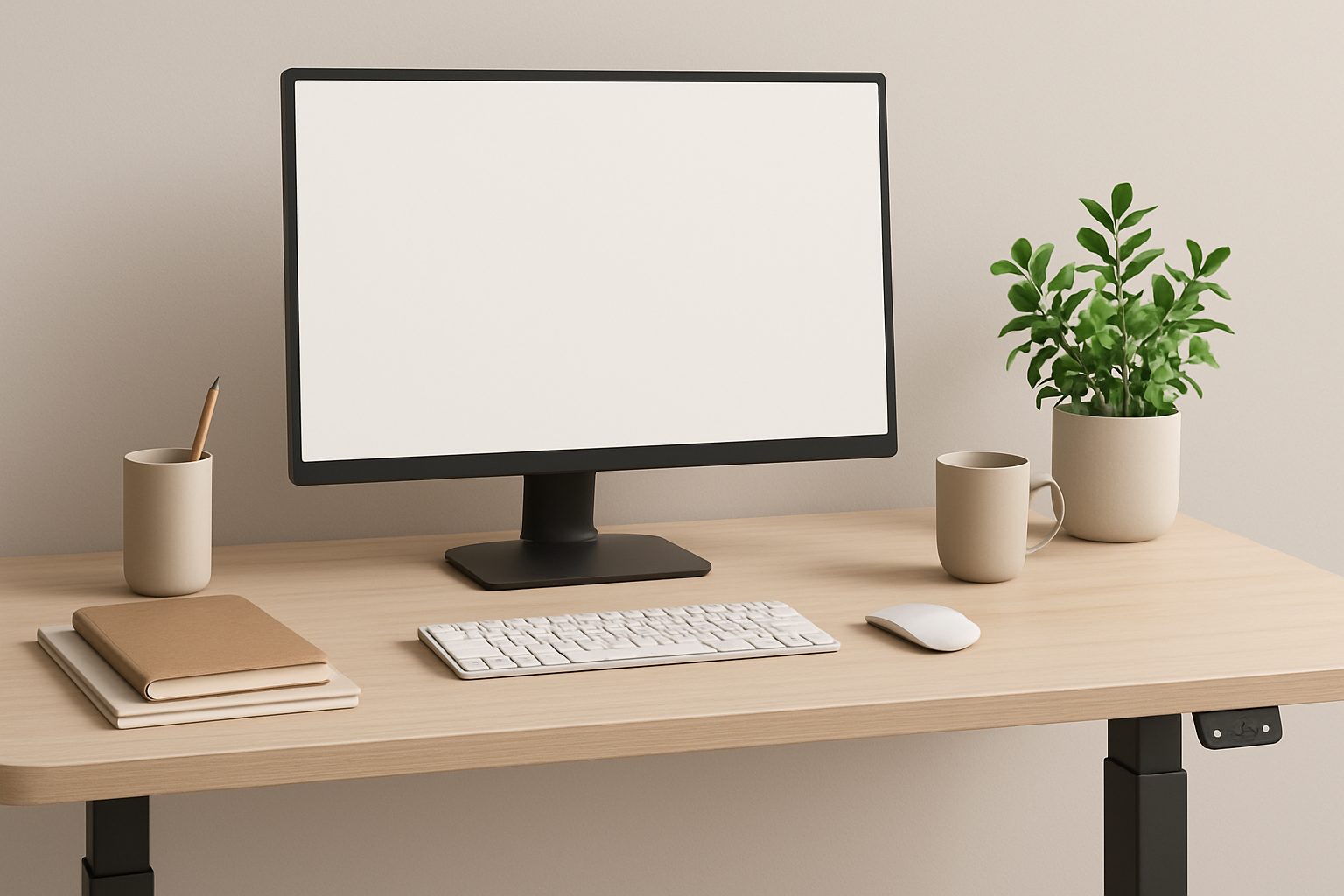
How to Choose an Electric Standing Desk in the UK — 7 Things to Check First
Electric standing desks are genuinely useful if you sit for most of your workday—switching between seated and standing positions can ease back strain and reduce the fatigue that comes from staying in one posture for eight hours. But buy the wrong one and you're left with a desk that won't reach your height, struggles under your monitor weight, or sounds like a construction site every time you adjust it. Here's what actually matters when choosing one in the UK market.
1. Height Range—Measure Your Space First
This is the most common mistake: people ignore their actual desk height needs and buy whatever's advertised as "ergonomic."
Measure the distance from your floor to your elbow when standing naturally with arms at 90 degrees. That's roughly where your desk surface should be when you're standing. Most people need between 72–80 cm. Do the same seated—you'll typically be 5–10 cm lower.
Check the spec sheet carefully. A desk with a range of 60–120 cm sounds flexible until you realise 60 cm is useless for standing (too low), and 120 cm is pointless for sitting if you're under 190 cm tall (too high). Look for desks with ranges like 66–116 cm or 71–121 cm, which cover most people without the wasted extremes.
If you're unusually tall or short, this becomes critical. A 180 cm person will find many budget desks max out below comfortable standing height. Budget desks aimed at "average" users often clip their range to cut costs.
2. Weight Capacity—Don't Assume It's Enough
A desk frame rated for 70 kg sounds robust until you realise you need to load it with a monitor, keyboard, books, a printer, and whatever else sits on your workspace.
Check what weight the manufacturer specifies per surface (desktop only) versus total system (frame plus everything on it). Some desks are rated for 100 kg total, which is tighter than it sounds when you start adding peripherals. A large dual-monitor setup, mechanical keyboard, and desk lamp can easily be 30–40 kg.
Safer desks in the UK market—proper commercial ranges rather than budget home-office stock—typically rate 100+ kg per surface. Single-motor desks are often 70–80 kg; dual-motor desks 100+ kg. If you're unsure what you'll load on top, buy one rated for at least 100 kg.
3. Motor Type—Single vs. Dual Motors
Single-motor desks are cheaper. They're also slower and noisier, and they struggle if weight is distributed unevenly (for example, if most of your stuff sits on one side).
Dual-motor desks have independent control of each leg, so they rise evenly and handle uneven loads better. They're quieter, faster, and more stable. They also cost more—sometimes 30–50% extra.
For most people in a home office, a quality single-motor desk works fine. In a shared space, the noise matters more; dual-motor desks are genuinely quieter. If you're putting a 32-inch monitor plus a printer on one side and nothing on the other, a dual-motor setup prevents the desktop from tilting slightly as it rises.
Check the motor specs: look for wattage (higher is usually better) and noise levels in decibels. Under 70 dB is quiet; over 75 dB is noticeable.
4. Frame Width—Narrower Than You Think
Desk frames come in standard widths, and they're often narrower than the desktop that sits on top. This is fine—desktops overhang the frame—but if you're planning to use cable management, monitor arms, or desk clamps, you need to know where the legs actually are.
Most UK desks come in 100 cm, 120 cm, or 140 cm frame widths. A 120 cm frame means the legs are roughly 100 cm apart, leaving space in the middle but limiting where you can attach things to the sides. If you're mounting multiple monitor arms or heavy equipment, tighter frame spacing can be an issue.
Look at the actual spec sheet or product images that show the leg positions, not just the overall desk width.
5. Noise Level—It Matters in Shared Spaces
A desk that sounds like a struggling industrial motor every time you adjust it gets old fast. It's also irritating to anyone else in the same room.
Dual-motor desks are typically 5–10 dB quieter than single-motor versions. Look for specific noise ratings if they're published; if not, read customer reviews. People mention noise levels honestly. Avoid desks where multiple reviews say "surprisingly loud" or "loud hum."
In a home office you're alone in, it's less critical. In a shared office or open plan, it matters.
6. Warranty—UK-Specific Terms Matter
Check what's covered and for how long. Motor warranties are often 3–5 years in the UK market; some cover parts and labour, others cover parts only (and labour is expensive).
Equally important: what happens if something fails? Can you return it to a UK address, or are you dealing with overseas returns? Some brands have UK support; others route everything through Europe or Asia.
Read the returns policy carefully. "30-day returns" sounds standard until you realise it's "at your cost" if you need to return a 140 cm desk frame. Some UK retailers will collect at home; others won't.
7. UK Returns Policy and Local Support
This is where many cheap imports stumble. If a desk arrives damaged or fails after a few months, you want to be able to return it or get parts locally without paying £80+ in shipping.
Buy from retailers that hold stock in the UK or have UK-based support teams. Yes, this usually means higher prices than direct-from-China imports, but the cost of troubleshooting a dead motor through an overseas seller is real frustration.
Check reviews specifically for what happens when people have problems. Does the brand replace parts? Do they have a UK phone number?
What to Do Now
Measure your space, list what you'll put on the desk, then search our roundup guides for desks that match those specs. Most desks in the mid-range (£300–700) tick all these boxes; it's the cheap extremes and premium brands that sometimes cut corners on one or two.
More options
- Flexispot E7 Pro Electric Standing Desk (Amazon UK)
- Flexispot E5 Budget Electric Standing Desk (Amazon UK)
- FEZIBO Electric Standing Desk UK (Amazon UK)
- Duronic Electric Sit-Stand Desk UK (Amazon UK)
- Anti-Fatigue Standing Desk Mat UK (Amazon UK)